~ Sustainable Seafaring from Oceania. History, Design, and Relevance ~

November 17, 2010

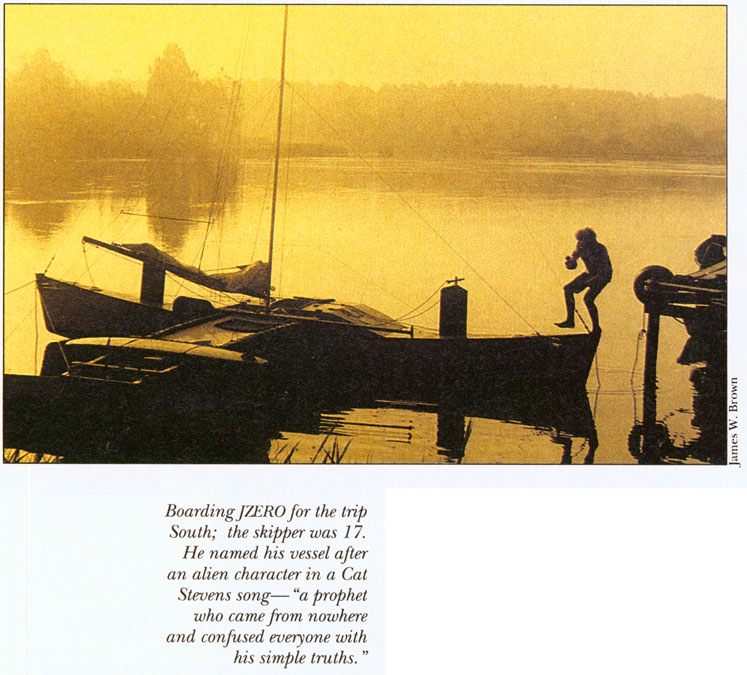
Sailing the original Jzero in 1978


Proa Jzero, 1978 - Sailing to Puerto Rico with Russ Brown, by Mark Balogh

"In March of 1978 Russ and I sailed his first cruising proa, Jzero of Polygor, from Ft. Pierce, Florida to Ponce, Puerto Rico. Jzero, was designed by Russ when he was 14 and built when he was 15 to escape (with parents permission) from home. Please understand that this was 20 years ago and most of this is from memory. IMHO Jzero was some of Russel's best design work and worst construction. Main hull without lee buoyancy pod was 30' by 2' and about 29'+ by 1.5' on the waterline. The ama was about 16' and the over beam was about 18' Jzero was mostly 1/4" fir ply and was 800+ pounds empty.

We sailed up hill against the current on mostly a one tack beat a few hundred miles out from the Bahamas until we were about 100+ miles north of San Juan in very deep water. A northeaster started to build. These things are hard to estimate or even remember but at its peak, the storm winds reached at least 50, maybe as high as 60. The waves were very high, looking higher than our 28' mast so I would guess some were 20 to 25 feet with some breaking off 5' to 10' of their tops. Bad spot for a lightly built boat.

We did not have a sea anchor. We made one out of my spare pair of jeans. A bridle was tied around the waist at one end and around the ankles of the pants at the other. This was tied to our anchor rode but the pants were too light and would skip out of the water when we were on top of a wave and the pull was upward. We added a small Danforth and some chain that I believe attached at the bridle and that mostly held the "sea anchor" in the water.

I recall that we discussed bridling the rode off between the aka and the main bow as we thought the downward pull on the ama might help, but in the end we ended up with the rode run off of just the main bow. Jzero rode very well in an attitude with the wind several degrees off the bow on the normal lee side. This put a little load on the ama but mostly just from the windage of the rig. We felt safer to sleep in this orientation. We rode for 2 to 3 days with no real problems. During the day when we could see the waves we would try to steer Jzero out to sea because on our drift course we were headed toward Navidad or where the water of the trench shoaled up to something like 6 fathoms off Martinique.

Luckily, the storm blew out as we were about due north of the Mona Passage. We were pretty tired and decided to run for the Passage and get to the lee of Puerto Rico in case another storm came. The Mona was quite roiled with a full blown refraction pattern consisting of two sets of fast, sometimes breaking swells with about a 45° to 90° angle between them. On almost a dead run in these seas in pitch black night, with a deep reefed 60 square foot main up, we covered 31 nautical miles in 2 hours flat and rounded the corner into the lee to get some rest. Jzero performed almost flawlessly the whole time. I was so impressed with this simple little boat that I drew up a very small 46' big sister as soon as I got home. I have never had the time to build it but would still like to have one some day.

Jzero was built for $400 and I helped Russ re-rig her in FL for about $800. She was the most impressive $1200 boat I ever sailed. Before the storm we had two really good days of steady wind close hauled on port tack. I couldn't get a sight for 48 hours but finally did and we had covered 360 miles under working sail of about 200 square feet. Aside from being wet, it was a comfortable ride. Just to give another example of her performance, later, in the St. Maarten Tradewinds race on a leg from Virgin Gorda, around St. Croix, to Martinique, about 350 miles essentially a one tack beat, Jzero finished third, I think less than 2 hours behind the leaders. The two lead boats were Rouge Wave sailed by Phil Weld and a 60 ft Peter Spronk cat (designed built owned sailed by Peter). I was crew on Third Turtle, an open wing 31 Val tri and we were hours behind."

The whole article is here:

November 15, 2010

Russell Brown interview

Jzero in the Med

The latter Jzerro in Australia


Interior of latter Jzerro


The original Jzero, built during the '70's.

Here at Chesapeake Light Craft, link courtesy of Proafile:
http://www.clcboats.com/life-of-boats-blog/russell-brown-on-proas.html

October 27, 2010

Star Rigging - the grand endeavor...

  Introduction to Star-Rigging


Simple is absolutely best.  The only reason to tinker with the already excellent Micronesian rig is to find a way to shunt the rig single-handedly in larger sizes, breezier conditions, and rougher sea states.  The goal is to tilt the mast under control with backstays and at the same time move the yard to the other end of the boat. 

I wanted a way to pair the line that would tilt the mast and the line that would move the yard over but discovered that those two lines moved through differing distances and at different rates.  Eventually I stumbled upon the present arrangement which allows those two lines to travel together, "married" as it were at a central attachment point, a ring, where all the lines meet and are snugged up.

The traveling block up on the mast allows the introduction of more (needed) line into the continuous backstay system and, oddly enough, the height of the block is not that critical.

A tackline moves the yard from one end to the other.  The tackline and the continous backstay work in trandem and accomplish the shunt with the operator working from amidships at the base of the mast, a good secure location.

... 
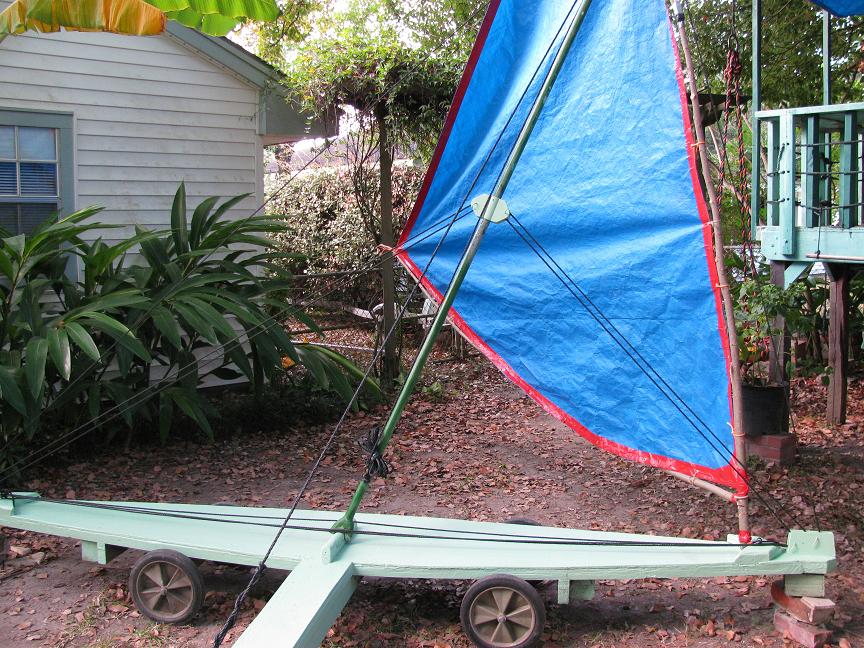
I went for the largest size model I could possibly patch together and I do mean patch together! I've built this almost entirely with found material. God is good and at each stage provided whatever material I've needed:The hull is of scrap wood
The mast is a fence post
The sail, post-Katrina blue polytarp
The spars are Mimosa branches
The lines are black poly from work
The sheaves are made of 2 x 4's
And so on...

With this model I intended to "make or break" the concept. 


This is the completed 12 foot model. Properly speaking, this is a "mock-up" built to further test a rig innovation. A small prototype was built earlier and performed well enough to justify a further exploration of the concept with a larger model.


October 26, 2010

In action


Here is the 12 foot model in action. The roughly fashioned parts work well and even with its cheap construction this model has yielded some good data and performs OK - 4 shunts in 30 seconds is respectable!
With further improvement, I'd rig my next proa this way. It should be practical in the 16 footer to 20-something foot range.

October 25, 2010

Another shot


This is another shot, slightly zoomed in at the end. The rigging shows up a little better.

October 13, 2010

The original 6 foot prototype model of Star-Rigging


This is the original 6 foot model, built in 2004. You can see that the general idea works well enough to explore further. Just by pulling a pair of lines (which are joined together) the mast tilts and the sail travels the length of the boat to arrive at the "new bow" simultaneously.

August 07, 2010

Hokule'a's Worldwide Voyage


A link to Hokule'a's upcoming Worldwide Voyage site: (some Satawal and canoe hauling footage)

July 29, 2010

On Mau - in remembrance


Mau Piailug : Last of the Pacific Navigators Finds his Way HomeJul 13, 2010 Brien Foerster

The last of the old traditional way finding navigators of the Pacific, Mau Piailug, died July 12, 2010, on his home island, Satawal.

When European explorers first ventured into the Pacific in the early 1500s, they found people on all the major islands. How the people got there was a mystery to them. They had no idea that they had happened upon a people who were the greatest explorers and navigators in the world; a people so skilled that they needed no maps or instruments to find their way across the vast ocean.

The last of these great traditional navigators, Mau Piailug, who guided the Hawaiian voyaging canoe Hokule'a on its first trip to Tahiti, using only non-instrument navigation in 1976, died on July 12, 2010, on the island of his birth, Satawal, in Micronesia.

The Education of the Navigator

Mau Piailug was born in 1932 on Satawal, a tiny Pacific island no wider than a mile in Micronesia. When he was still a little baby, his grandfather put him in a tide pool as though he were putting him in a cradle. There the sea gently rocked him back and forth with the rhythm of the tides.

When Mau was six, his grandfather began to teach him about navigation. He started by telling him about the stars; the grandfather made a star compass out of a circle of coral rocks, and in the center he put a little canoe he had made of palm fronds. Then he explained how the stars rose in the sky and traveled from east to west.

As he grew older, Mau spent his evenings in the canoe house. There he asked the elders to teach him about navigation. In this way, and with his grandfather's help, he learned the paths of more than a hundred stars. He also learned that when clouds covered the sky, he could use the direction of the ocean waves to guide the canoe. He could also follow the birds toward land when they headed home in the evening, and he studied the creatures of the sea, for in times of trouble they, too, could help him find land.

At the age of 11 or 12, he was so eager to learn that he was sent to a master navigator, a Palu, who lived on a nearby island. And when Mau was 18 or so he was made a Palu, too, in a special ceremony called Pwo.

For the next 20 years, Mau sailed his canoe in the old way. He fished, and he raised a family. He took pride in being a Palu, but during those years Satawal was changing. An elementary school was built on the island, and the children turned to books instead of their elders for learning.

They no longer came to the canoe house to seek wisdom, and the Pwo ceremony was stopped. On island after island across the Pacific, the old navigators died without passing on their knowledge. And Mau was now afraid that this would happen on Satawal, too.

In 1974 he was invited by the Polynesian Voyaging Society of Hawaii to assist them in reviving the ancient art and science of Hawaiian way-finding. As oral tradition and even archaeological evidence had shown, the Hawaiians had come from Tahiti as far back as the 12th century, if not the time of Christ.

Many western scholars had suggested that the discovery of Hawaii had been accidental, that a canoe had been blown off course. Hawaiian oral tradition knew better; they have a complete geneology going back to when the great voyager Hawai'iloa, along with his navigator Makali'i had first set foot on Hawaiian soil.

Indeed, Captain James Cook was only able to "discover" Aotearoa (New Zealand) and Hawaii with the aid of traditional navigators from the island of Raiatea in Tahiti, who sailed with Cook and guided him to these islands. Cook had blank charts of the areas, and the navigators held the knowledge of the precise locations of them in their minds.

Renaissance of Hawaiian Voyaging

Mau was asked to navigate the Hokule'a; it was an honor, but he did not know if he could make the 2,500-mile journey to Tahiti. He was unfamiliar with the seas, the winds, or even the stars that far south. A visit was made to the local planetarium in Honolulu, where Mau could look at the star map overhead and memorize the positions of those stars that would guide him and the crew of Hokule'a safely to Tahiti.
For 33 days, from May 1 to June 4, 1976, Mau seemed never to sleep. He watched the changing colours of the sky and the sea; he felt the temperature of the air and the water, and he tasted the saltiness of the ocean and listened to the sound of the waves slapping against the hull.

When the Hokule'a arrived safely in Tahiti, reporters spread the news around the world. The successful voyage not only bolstered the pride of the Hawaiians, but all of the people of the Pacific whose ancestors could smile, knowing that their knowledge was alive and growing.

He spent the majority of his final years back home on Satawal. To say that he will be missed is obvious; to say that he acted as a bridge of knowledge from the past to the future is accurate; and to say that he was a great man with a gentle heart and a mind that was a navigational computer is true.

The following are the words of an ancient Satawal chant, telling the people to accept the gifts of the past and be ready to pass them on :
'I will reach behind.
I will reach ahead.'

Sources:
www.hokuleawwv.org/about-voyage/worldwide-voyage/inspiration/mau-piailug
pvs.kcc.hawaii.edu/index/our_founders_our_teachers.htmlRead more at Suite101: Mau Piailug : Last of the Pacific Navigators Finds his Way Home http://news.suite101.com/article.cfm/mau-piailug--the-last-star-navigator-finds-his-way-home-a261042#ixzz0v5wo2mtC