Papa Mau, The Wayfinder:
http://www.youtube.com/watch?v=0rCuSyvsCcg&feature=related
An actual website devoted to the film:
http://papamau.com/
~ Sustainable Seafaring from Oceania. History, Design, and Relevance ~
July 18, 2012
July 17, 2012
The definitive Mau article - at Wikipedia
A greatly exanded article on Mau here at Wikipedia:
http://en.wikipedia.org/wiki/Mau_Piailug
Polynesian seafaring - history and Hawaiian re-creation
- voice of Captain Cook by Patrick Steward
http://www.youtube.com/watch?v=ghojMWv5AZA&feature=related
And here, a PBS site - Wayfarers, a Pacific Odyssey:
http://www.pbs.org/wayfinders/
The Canoe is the People, CD ROM:
http://portal.unesco.org/science/en/ev.php-URL_ID=3543&URL_DO=DO_TOPIC&URL_SECTION=201.html
Also of note: Both Mau and Hipour of Puluwat were of the Weriyeng school of navigation - see this article at Wikipedia:
http://en.wikipedia.org/wiki/Weriyeng
http://en.wikipedia.org/wiki/Mau_Piailug
Polynesian seafaring - history and Hawaiian re-creation
- voice of Captain Cook by Patrick Steward
http://www.youtube.com/watch?v=ghojMWv5AZA&feature=related
And here, a PBS site - Wayfarers, a Pacific Odyssey:
http://www.pbs.org/wayfinders/
The Canoe is the People, CD ROM:
http://portal.unesco.org/science/en/ev.php-URL_ID=3543&URL_DO=DO_TOPIC&URL_SECTION=201.html
Also of note: Both Mau and Hipour of Puluwat were of the Weriyeng school of navigation - see this article at Wikipedia:
http://en.wikipedia.org/wiki/Weriyeng
![]() |
| How did Sam Low get Mau to smile like this! |
June 19, 2012
June 06, 2012
On lashing and caulking
"Upon this hull is built up the top side planking, which, in the specimen under consideration is on the starboard side of one piece twelve feet four inches in length and eight inches in greatest depth; on the port side it is in two pieces, fourteen feet in length, and nine inches in greatest depth; both are an inch thick, adzed level to the deck above and sinuous below to follow the irregular curves of the hull. To the hull this planking is attached by a series of lashings placed at intervals of from four to ten inches. The lashings, consisting always of the flat sinnet braid called "kafa," are passed four times through holes bored half an inch within the edge, and knotted at each pair of holes, never being carried along from pair to pair. Where on the port side two planks join, a triangular lashing attaches each to each and to the hull. I have no reliable information of the composition and application of the caulking used in the seams.
The Tahitians caulked their canoes with the husk of coconut and gum of breadfruit;† the Penrhyn Islanders stopped holes and seams with coconut husk steeped in water and pounded like flax;‡ and the Solomon Islanders used a kind of vegetable putty from the nut of Parinarium laurinum."
June 05, 2012
Caroline Islands canoes
From here, a "show-all" search on canoes:
http://nzetc.victoria.ac.nz/tm/scholarly/facets/search?&fq=record_type:facet&facet=true&facet.mincount=1&q=all:canoes&facet.limit=6&qt=standard&rows=78&fq=type:Page_in_Work
Caroline Islands canoes:
http://nzetc.victoria.ac.nz/tm/scholarly/tei-BesCano-t1-body-d6-d4-d2.html
The entire text here:
"Canoes of Caroline Islands
Morrell, who cruised among the Caroline Islands in 1830, speaks as follows of the canoes of the natives -
The canoes of these natives are mostly of great length, carrying from fifteen to thirty men. The bottom is of one log, generally from thirty to fifty feet in length, and got out [hewn out] in the form of a canoe… On this foundation they proceed to build the vessel. Each side is formed of a single plank, from fourteen to eighteen inches in width, making the depth of the boat; but the two sides are not alike, one being nearly flat and straight next the water, and the other somewhat bulging. These sides are sewed fast to the bottom with a strong cord made from the bark of a tree, and also to a beautifully carved head and stern, resembling those of the ancient galleys which we often meet with in classical paintings.
As these canoes are frequently propelled by sails, and as the bulging side is always to windward, the reader will naturally suppose that it could not long retain an upright position, but would be liable to be upset. This is prevented, however, by a very ingenious contrivance. A frame, called an outrigger, projects out eight or ten feet horizontally from the rounded, bulging, or windward side, at the extreme end of which is attached a piece of buoyant wood, shaped something like a canoe. The weight of this apparatus prevents the boats capsizing to leeward, while that side being flat prevents her making leeway. At the same time the buoyancy of the outrigger and bamboo frame renders it impossible for her to overset to windward. This is the form and construction of their single canoes, which go through the water with great velocity, whether propelled by paddles or sails, or both.
Their double canoes are formed in the same manner as the one just described, with the exception of the outrigger, which, of course, is not necessary. Two canoes are fastened together abreast of each other, with bamboos extended across them, on the same principle of construction as our twin ferry-steamboats. These canoes are generally about forty feet in length, and the distance between them is from eight to ten feet. The bamboos which unite them are placed about two feet apart, and strongly secured to the gunnels by a lashing of their bark cord. Small sticks of bamboo are then extended fore and aft, secured to the cross-pieces, thus forming a light platform from twenty to twenty-five feet in length, and eight or ten feet wide. They paddle on the two outsides and insides of the canoes, propelling them forward with astonishing speed, much swifter than our whaleboats with six oars pulled by our most vigorous tars. These are called war-canoes, and many of them have very curiously carved heads and sterns, which rise from one to three feet above the hull, not unlike the fashion of the New-Zealanders. Their paddles are generally four feet in length, with blades about six inches wide, the whole very neatly finished off with carved work, admirably executed.
Their sails for the single canoes are made, like their own garments, of a beautiful long grass, which they have the art of weaving into a strong substantial cloth. These sails are shaped like what is called a 'shoulder of mutton,' and used in the following manner: The mast stands exactly perpendicular in the centre of the canoe, being from twelve to eighteen feet in height. At the head of this mast is hoisted a yard, proportioned to the size of the canoe, from twenty-five to thirty-five feet in length. The sail spreads this yard, and when hoisted at the masthead its foot sweeps the gunnel of the canoe. These sails are set in such a manner that the canoes never need go in stays when beating to windward, being so constructed as to go either end foremost. When they wish to go on the other tack, she suddenly falls off until the other end of the boat becomes the head, and luffs up to the wind; by which time the men have raised the tack on the depressed end of the yard, and brought its opposite extremity down to the other end of the boat. Thus she hugs the wind on either side by turns, without ever looking directly in its teeth.
I have seen these boats going at the rate of eight miles an hour, within four points of the wind. But let them run large, or before the wind, with a strong breeze, and I have no doubt but they will go at the rate of twelve or thirteen miles an hour in smooth water. By only shifting the sail, with a side wind, these canoes will pass, back and forth, between two islands, each end alternately foremost, with great rapidity, without the necessity of putting about. The sails are made in small pieces of about three feet square, sewed together. In cutting the sail to its proper shape, the pieces which come off one side answer to go on the other; this gives it the proper form, and causes the halliards to be bent on in the middle of the yard.
These hewn-out hulls with single wide top-strakes sewn on, and carved head and stern pieces, remind us of New Zealand craft. The straight side to leeward acted as a lee-board: this is seen in the Indian Archipelago, but no such form is reported from Polynesia. It appears at the Gilbert Group. The sail appears to be that of the Fijian and Tongan Groups. Morrell does not mention the balance-platform in his account.
Arago tells us that no native of the Caroline Islands is allowed to marry until he has given proof of his dexterity in steering a proa: "For this examination a time is chosen when the sea is rather high. The candidate is placed at the sheet (for they steer their vessels entirely by the sails), and there, surrounded by reefs, and in the midst of foaming waves, he must make his proa sail a certain distance without allowing its balancer to touch the waves. I could not have believed that they possessed so much skill if I had not sailed in their vessels."
Dampier describes a form of proa seen by him at Mindanao, Philippine Isles, with what he calls an "outlayer" on each side. These were not true outriggers, but two projecting balance-platforms, one on either side, neither of which touched the water when the craft was on an even keel. "The boat is not flat on one side here, as at page 372Guam; but hath a Belly and Outlayers on each side; and whereas at Guam there is a little Boat fastened to the Outlayers, that lies in the Water, the Beams or Bamboos here are fastened traverse-wise to the Outlayers on each side, and touch not the Water like Boats, but one, three, or four foot above the Water, and serve for the Bargemen to sit and row and paddle on; the inside of the Vessel, except only just afore and abaft, being taken up with the apartments for the passengers. There run across the Outlayers two tire of Beams for the Paddlers to sit on, on each side of the Vessel. The lower tire of these Beams is not above a foot from the Water; so that, upon any reeling of the Vessel, the Beams are dipt in the Water, and the men that sit are wet up to their waste; their feet seldom escaping the water. And thus, as all our Vessels are Rowed from within, these are Paddled from without."
D'Urville's illustrations of canoes of the Caroline Group show a comparatively short outrigger, with a balance-platform on the opposite side. There is also a platform on the booms of a triangular form, which is formed by covering with rods not only the space between the two booms, but also the spaces between the booms and the two side braces or struts, which resemble those of the Vanikoro canoe. There appears to be a roofed cabin on each of the platforms. The ends of the canoe are much elevated. The sail is of the lateen form, with two yards, and the mast nearly upright; the paddle depict-page 373ed resembles the Maori form. The hold is open throughout its length, except at the middle. Another canoe, of a larger type, shows a narrow hull, long booms on which several longitudinal spars are lashed, and on these, immediately over the booms, other poles are lashed, apparently to strengthen the structure. The balance-platform, like those of Vanikoro, is not horizontal but tilted upwards. The latter carries an awning-like roof, and the boom platform a thatched cabin. The paddle shown is not of Maori form; it may be a steer-oar."
http://nzetc.victoria.ac.nz/tm/scholarly/facets/search?&fq=record_type:facet&facet=true&facet.mincount=1&q=all:canoes&facet.limit=6&qt=standard&rows=78&fq=type:Page_in_Work
Caroline Islands canoes:
http://nzetc.victoria.ac.nz/tm/scholarly/tei-BesCano-t1-body-d6-d4-d2.html
The entire text here:
"Canoes of Caroline Islands
Morrell, who cruised among the Caroline Islands in 1830, speaks as follows of the canoes of the natives -
The canoes of these natives are mostly of great length, carrying from fifteen to thirty men. The bottom is of one log, generally from thirty to fifty feet in length, and got out [hewn out] in the form of a canoe… On this foundation they proceed to build the vessel. Each side is formed of a single plank, from fourteen to eighteen inches in width, making the depth of the boat; but the two sides are not alike, one being nearly flat and straight next the water, and the other somewhat bulging. These sides are sewed fast to the bottom with a strong cord made from the bark of a tree, and also to a beautifully carved head and stern, resembling those of the ancient galleys which we often meet with in classical paintings.
As these canoes are frequently propelled by sails, and as the bulging side is always to windward, the reader will naturally suppose that it could not long retain an upright position, but would be liable to be upset. This is prevented, however, by a very ingenious contrivance. A frame, called an outrigger, projects out eight or ten feet horizontally from the rounded, bulging, or windward side, at the extreme end of which is attached a piece of buoyant wood, shaped something like a canoe. The weight of this apparatus prevents the boats capsizing to leeward, while that side being flat prevents her making leeway. At the same time the buoyancy of the outrigger and bamboo frame renders it impossible for her to overset to windward. This is the form and construction of their single canoes, which go through the water with great velocity, whether propelled by paddles or sails, or both.
Their double canoes are formed in the same manner as the one just described, with the exception of the outrigger, which, of course, is not necessary. Two canoes are fastened together abreast of each other, with bamboos extended across them, on the same principle of construction as our twin ferry-steamboats. These canoes are generally about forty feet in length, and the distance between them is from eight to ten feet. The bamboos which unite them are placed about two feet apart, and strongly secured to the gunnels by a lashing of their bark cord. Small sticks of bamboo are then extended fore and aft, secured to the cross-pieces, thus forming a light platform from twenty to twenty-five feet in length, and eight or ten feet wide. They paddle on the two outsides and insides of the canoes, propelling them forward with astonishing speed, much swifter than our whaleboats with six oars pulled by our most vigorous tars. These are called war-canoes, and many of them have very curiously carved heads and sterns, which rise from one to three feet above the hull, not unlike the fashion of the New-Zealanders. Their paddles are generally four feet in length, with blades about six inches wide, the whole very neatly finished off with carved work, admirably executed.
Their sails for the single canoes are made, like their own garments, of a beautiful long grass, which they have the art of weaving into a strong substantial cloth. These sails are shaped like what is called a 'shoulder of mutton,' and used in the following manner: The mast stands exactly perpendicular in the centre of the canoe, being from twelve to eighteen feet in height. At the head of this mast is hoisted a yard, proportioned to the size of the canoe, from twenty-five to thirty-five feet in length. The sail spreads this yard, and when hoisted at the masthead its foot sweeps the gunnel of the canoe. These sails are set in such a manner that the canoes never need go in stays when beating to windward, being so constructed as to go either end foremost. When they wish to go on the other tack, she suddenly falls off until the other end of the boat becomes the head, and luffs up to the wind; by which time the men have raised the tack on the depressed end of the yard, and brought its opposite extremity down to the other end of the boat. Thus she hugs the wind on either side by turns, without ever looking directly in its teeth.
I have seen these boats going at the rate of eight miles an hour, within four points of the wind. But let them run large, or before the wind, with a strong breeze, and I have no doubt but they will go at the rate of twelve or thirteen miles an hour in smooth water. By only shifting the sail, with a side wind, these canoes will pass, back and forth, between two islands, each end alternately foremost, with great rapidity, without the necessity of putting about. The sails are made in small pieces of about three feet square, sewed together. In cutting the sail to its proper shape, the pieces which come off one side answer to go on the other; this gives it the proper form, and causes the halliards to be bent on in the middle of the yard.
These hewn-out hulls with single wide top-strakes sewn on, and carved head and stern pieces, remind us of New Zealand craft. The straight side to leeward acted as a lee-board: this is seen in the Indian Archipelago, but no such form is reported from Polynesia. It appears at the Gilbert Group. The sail appears to be that of the Fijian and Tongan Groups. Morrell does not mention the balance-platform in his account.
Arago tells us that no native of the Caroline Islands is allowed to marry until he has given proof of his dexterity in steering a proa: "For this examination a time is chosen when the sea is rather high. The candidate is placed at the sheet (for they steer their vessels entirely by the sails), and there, surrounded by reefs, and in the midst of foaming waves, he must make his proa sail a certain distance without allowing its balancer to touch the waves. I could not have believed that they possessed so much skill if I had not sailed in their vessels."
Dampier describes a form of proa seen by him at Mindanao, Philippine Isles, with what he calls an "outlayer" on each side. These were not true outriggers, but two projecting balance-platforms, one on either side, neither of which touched the water when the craft was on an even keel. "The boat is not flat on one side here, as at page 372Guam; but hath a Belly and Outlayers on each side; and whereas at Guam there is a little Boat fastened to the Outlayers, that lies in the Water, the Beams or Bamboos here are fastened traverse-wise to the Outlayers on each side, and touch not the Water like Boats, but one, three, or four foot above the Water, and serve for the Bargemen to sit and row and paddle on; the inside of the Vessel, except only just afore and abaft, being taken up with the apartments for the passengers. There run across the Outlayers two tire of Beams for the Paddlers to sit on, on each side of the Vessel. The lower tire of these Beams is not above a foot from the Water; so that, upon any reeling of the Vessel, the Beams are dipt in the Water, and the men that sit are wet up to their waste; their feet seldom escaping the water. And thus, as all our Vessels are Rowed from within, these are Paddled from without."
D'Urville's illustrations of canoes of the Caroline Group show a comparatively short outrigger, with a balance-platform on the opposite side. There is also a platform on the booms of a triangular form, which is formed by covering with rods not only the space between the two booms, but also the spaces between the booms and the two side braces or struts, which resemble those of the Vanikoro canoe. There appears to be a roofed cabin on each of the platforms. The ends of the canoe are much elevated. The sail is of the lateen form, with two yards, and the mast nearly upright; the paddle depict-page 373ed resembles the Maori form. The hold is open throughout its length, except at the middle. Another canoe, of a larger type, shows a narrow hull, long booms on which several longitudinal spars are lashed, and on these, immediately over the booms, other poles are lashed, apparently to strengthen the structure. The balance-platform, like those of Vanikoro, is not horizontal but tilted upwards. The latter carries an awning-like roof, and the boom platform a thatched cabin. The paddle shown is not of Maori form; it may be a steer-oar."
May 31, 2012
Our Blue Canoe
Our Blue Canoe - the trailer:
http://www.youtube.com/watch?feature=player_embedded&v=UR_nk7ZEKcE
Our Blue Canoe - trailer 2:
http://www.youtube.com/watch?v=iKbIeBfF4eo
Article at Proafile:
http://proafile.com/magazine/article/our-blue-canoe
Pacific Voyagers.org:
http://pacificvoyagers.org/
http://www.youtube.com/watch?feature=player_embedded&v=UR_nk7ZEKcE
Our Blue Canoe - trailer 2:
http://www.youtube.com/watch?v=iKbIeBfF4eo
Article at Proafile:
http://proafile.com/magazine/article/our-blue-canoe
Pacific Voyagers.org:
http://pacificvoyagers.org/
May 30, 2012
May 13, 2012
Daily Life aboard Hokulea
Courtesy of: http://pvs.kcc.hawaii.edu/ike/canoe_living/daily_life.html
"Once you go on the canoe, because it's so small, you try to make it like one family."--That is the sailing philosophy of Snake Ah Hee, a 16-year veteran crew member of the Hokule'a. For a dozen plus people to live happily and harmoniously in tight living quarters and over thousands of miles, he and other crew members know the right mental a nd emotional attitude is key.
Living space is tight--the deck is about 40 feet long and 10 feet wide, totaling 400 square feet.
Sleeping quarters are even more cramped and less than comfortable. The sleeping compartments run the length of both sides of the deck and are covered with canvas. Individual spa ces measure about 6 feet in length and 3 feet across, usually with two crew members assigned to each space. One person sleeps while the other stands watch. Personal belongings are stowed here, with each crew member allowed one 48 quart cooler. Beds consist of a board placed over the coolers, covered by a sleeping pad.


Going to the bathroom involves strapping a safety harness on, hooking the harness to a railing or safety line, and then relieving yourself overboard while standing or sitting on the running board on the outside of the hull. The flushing action depends on how fast the canoe is going and how rough the seas are.
In calmer conditions, a bucket of water is used.
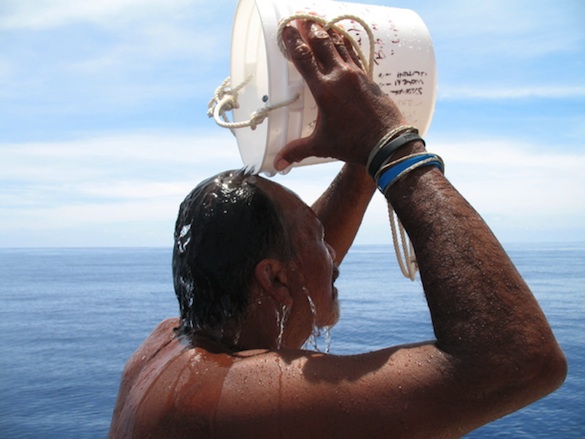
Bathing is done either forward or aft on the canoe. Forward, you sit in a net slung between the two canoe hulls. Aft, you bathe in an open compartment, pulling salt water up in a 5 gallon bucket. You use a special sea soap, which makes bathing in salt water actually refreshing.
Because the canoe is so small, privacy is limited at best, but all crew members respect the needs of others. Generally, when someone is bathing or going to the bathroom, the rest of the crew moves away out of courtesy. When women are sailing, certain acco mmodations are made, such as hanging a curtain over the aft bathing area.
Cooking is done in the center of the canoe. The galley, or kitchen, is a two burner propane gas stove housed in a metal box. By necessity, most of the food on board comes out of a box or can, supplemented by whatever fresh fish the crew can catch. Each vo yage has a designated fisherman, who puts his trolling lines out off the back of the canoe every morning.

The canoe carries bottled fresh water for cooking and drinking. On an estimated 30 day voyage the canoe will carry enough water for 40 days at sea. If water supplies become too low, the captain can order that water be rationed. Crew members also store rai n water for cooking and bathing.
It takes a lot of work to sail Hokule'a and everyone is assigned a job. Crew members are divided into watches, teams of people who work specific shifts. On the normal three-team watch system, each person works a four hour shift twice a day, with eight hours off in between. If you are on the 2 to 6 watch, you'll work from 2 to 6 in the morning and the again from 2 to 6 in the afternoon. In bad weather, the crew may go to a two-team watch system.
The watch on duty is responsible for maintaining the canoe, working the steering paddles, handling the sails and keeping water out of the compartments. At the start of watch the crew runs through a safety checklist to ensure that Hokule'a is in optimum sailing condition. Each watch has a captain responsible for supervising the others on his or her team.


The person who carries the overall responsibility for the canoe and crew is the sailmaster. While he serves primarily in an advisory capacity, it is the sailmaster who has the final say on the canoe's sailing strategy and course and on all other operations of the canoe. He works in consultation with the navigators and captain.
The navigator, who is usually the same person as the sailmaster, determines the canoe's course, sets the sailing strategy, and determines the direction in which the crew will sail Hokule'a. He must stay oriented at all times, and this means that generally he is assigned no other duties aboard the canoe. In order to keep track of the canoe's direction, the navigator stays awake 20 hours a day, seated on a platform at the aft of the canoe. The navigator gives direction to the crew through the captain. The crew on watch steers the canoe under the direction of the navigator and captain, working the steering sweep and paddles and trimming the sails to stay on course while maintain the maximum speed.
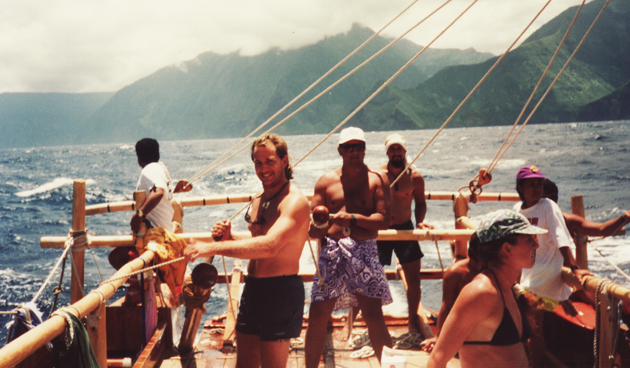
The captain's primary responsibility is the safe sailing of Hokule'a and this encompasses everything from ensuring that a capable well-trained crew is on board to the physical maintenance of the canoe. Much preparation is done before the crew and canoe ever leave shore and this is done under the captain's direction. In consultation with the other officers, the captain schedules work parties for preparing the canoe to sail. Re-lashing canoe parts, mending sails, cleaning and painting Hokule'a's hulls are just some examples of the kinds of work done before sailing.
Another big job is loading the canoe with food, water, and safety gear required on voyages. Again, it is the captain's responsibility to ensure that this is done properly.
At sea, the captain executes all decisions relative to sailing. Once the navigator sets the sailing strategy, it is the captain who directs the crew to hoist, drop or change sails and he determines which steering paddles to use. He is responsible for coo rdinating activities with the escort vessel and providing a daily work schedule for the watch captains. The captain holds overall responsibility for maintaining the canoe's inventory, and he decides when and if to ration food and water. When approaching l and, the captain handles most administrative matters, such as dealing with customs officials and maintaining the canoe's security while it is moored.
The watch captains direct those crew members assigned to their watch or work shifts, carrying out instructions relayed by the captain. The watch captain is responsible for ensuring that his crew is up and on duty in a timely fashion, assigning specific st eering positions to his crew and directing rotations through the various positions, going through the safety check list, and maintaining his watch log. He is responsible for maintenance of the canoe during his watch, including cleaning up after meals. Add itionally, the watch captain is responsible for monitoring the safety, health and morale of his crew.
Other tasks are assigned to crew members and carried out in addition to standing watch. The medical officer, usually a certified doctor, is aboard Hokule'a for each long voyage. His primary responsibility is the health of the crew. It is the medical offic er's responsibility to ensure that the canoe is equipped with all medications and medical supplies needed for a long journey. When the canoe is in foreign ports, the medical officer is also responsible for attending to the crew's health and medical needs on shore.
The radio operator handles all radio transmissions between Hokule'a, and the escort vessel and between the canoe and land. He maintains an accurate log of all radio traffic, and is responsible for the upkeep of the radio equipment.
A designated carpenter oversees all repairs done on the canoe. He also maintains the tool inventory. An assigned electrician maintains all electrical systems.
The cook plans the canoe's menus, maintains iventory of food supplies, and does most of the cooking. While this may not seem like an important job, the ability of the cook is directly related to the morale of the crew as meals are the highlight of each da y. Good nutrition is also an important factor in maintaining the health of the crew.
The quartermaster is responsibile for provisioning the canoe--loading food, water and all needed supplies, and for maintaining Hokule'a's inventory. While this is not an on board job, it is critical to the safe and efficient sailing of the canoe. Weight m ust be evenly distributed for optimum sailing.
Fishing off of the canoe is not a leisure time activity, but an actual designated job, and one crew member is responsible for setting and bringing in fishing lines each day and for landing all catches. Fresh fish provide an important food source at sea.
Documentors keep historical records of the voyage by various means including writing, video and audio taping.
The safety officer is responsible for all safety and emergency systems and equipment. Life jackets, life preservers, flares and fire extinguishers are just some examples of the gear the canoe carries. In addition, all crew members must be trained in man o verboard and fire procedures.
Crew responsibilities are exactly the same as the watch captain, with the exception of the administrative duties. Off watch, crew members main obligation is to keep out of the way of those on duty.
Leisure time is spent in a variety of ways including resting, reading, writing, and taking care of personal chores (laundry, cleaning out compartments etc.). In the event of bad weather or an emergency and an all hands on deck call, all of the crew member s are expected to work.
All jobs on the canoe, no matter how routine they may seem, are important to the overall safe sailing of Hokule'a. A crew member's most critical responsibility is to realize that his crewmates depend upon him to carry out his assigned duties, and to work well as part of a team.
"Once you go on the canoe, because it's so small, you try to make it like one family."--That is the sailing philosophy of Snake Ah Hee, a 16-year veteran crew member of the Hokule'a. For a dozen plus people to live happily and harmoniously in tight living quarters and over thousands of miles, he and other crew members know the right mental a nd emotional attitude is key.
Living space is tight--the deck is about 40 feet long and 10 feet wide, totaling 400 square feet.
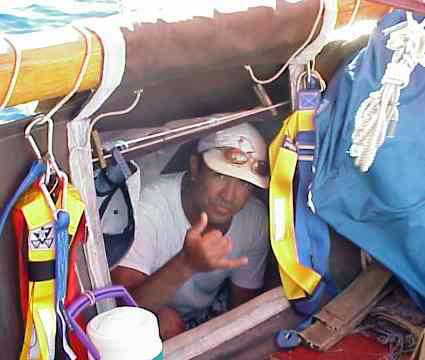
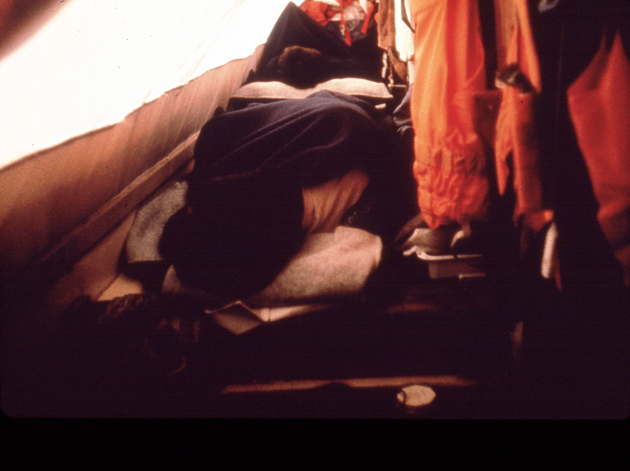
Sleeping quarters are even more cramped and less than comfortable. The sleeping compartments run the length of both sides of the deck and are covered with canvas. Individual spa ces measure about 6 feet in length and 3 feet across, usually with two crew members assigned to each space. One person sleeps while the other stands watch. Personal belongings are stowed here, with each crew member allowed one 48 quart cooler. Beds consist of a board placed over the coolers, covered by a sleeping pad.

Kawika Crivello looking out from the sleeping quarters

Inside the sleeping quarters
Bathroom facilities, located on either side of the canoe, take things right down to basics.

Bathing is done either forward or aft on the canoe. Forward, you sit in a net slung between the two canoe hulls. Aft, you bathe in an open compartment, pulling salt water up in a 5 gallon bucket. You use a special sea soap, which makes bathing in salt water actually refreshing.

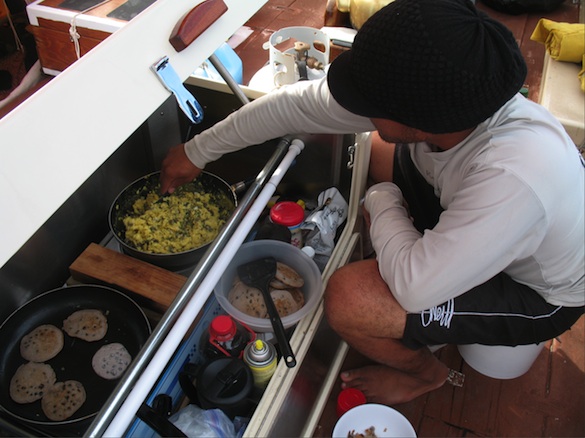
Cooking is done in the center of the canoe. The galley, or kitchen, is a two burner propane gas stove housed in a metal box. By necessity, most of the food on board comes out of a box or can, supplemented by whatever fresh fish the crew can catch. Each vo yage has a designated fisherman, who puts his trolling lines out off the back of the canoe every morning.

Pancakes and eggs for breakfast.
On long trips, food is much more than a source of nutrition and sustenance. Mealtime is one of the few times during the day that the entire crew is together on deck. On long monotonous days, meals are a highlight. When the weather is cold and rainy, a hot meal can do wonders for morale.The canoe carries bottled fresh water for cooking and drinking. On an estimated 30 day voyage the canoe will carry enough water for 40 days at sea. If water supplies become too low, the captain can order that water be rationed. Crew members also store rai n water for cooking and bathing.
It takes a lot of work to sail Hokule'a and everyone is assigned a job. Crew members are divided into watches, teams of people who work specific shifts. On the normal three-team watch system, each person works a four hour shift twice a day, with eight hours off in between. If you are on the 2 to 6 watch, you'll work from 2 to 6 in the morning and the again from 2 to 6 in the afternoon. In bad weather, the crew may go to a two-team watch system.
The watch on duty is responsible for maintaining the canoe, working the steering paddles, handling the sails and keeping water out of the compartments. At the start of watch the crew runs through a safety checklist to ensure that Hokule'a is in optimum sailing condition. Each watch has a captain responsible for supervising the others on his or her team.

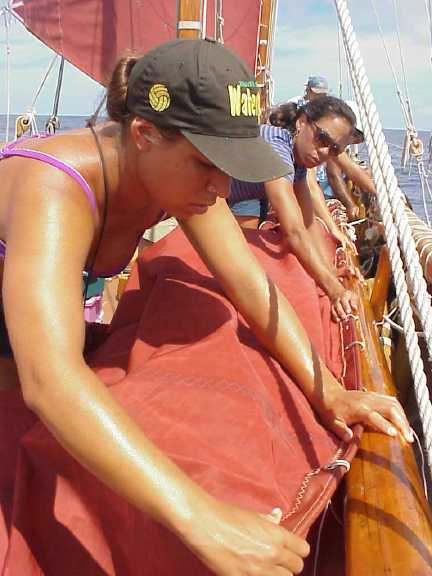
Changing Sails. Tahiti-Hawai‘i 2000.

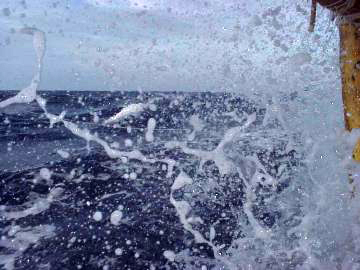
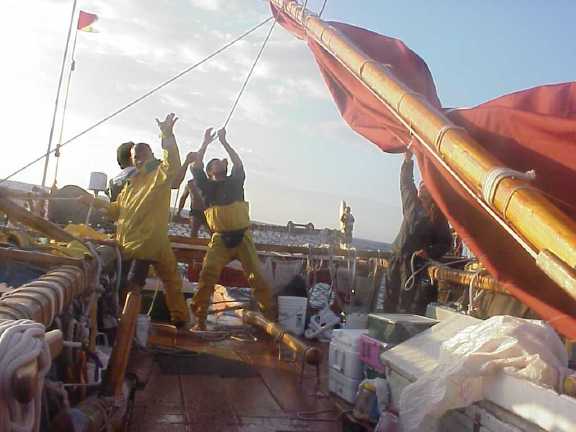
Lowering the rig to prepare for a squall. Tahiti-Hawai‘i 2000.

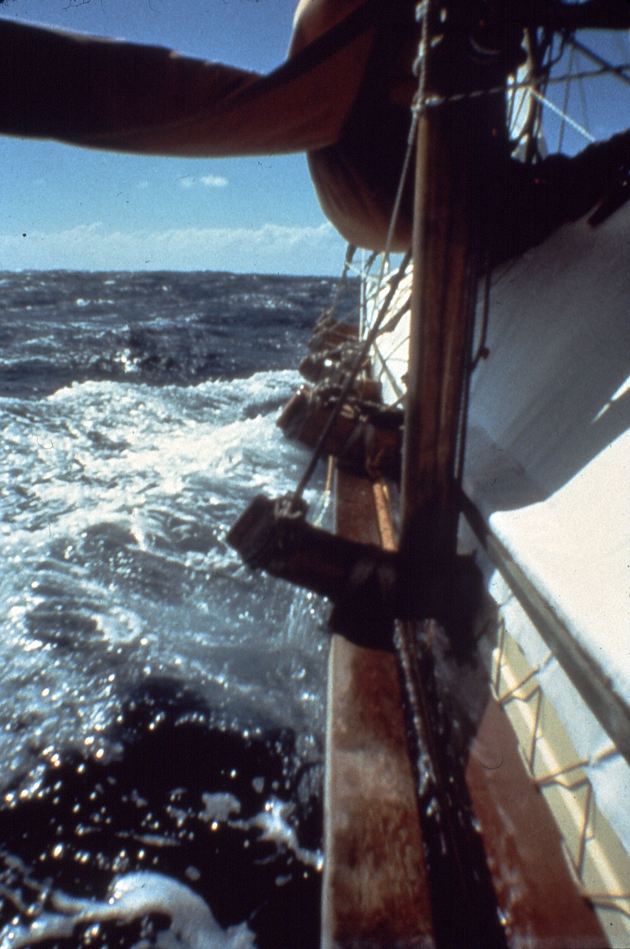
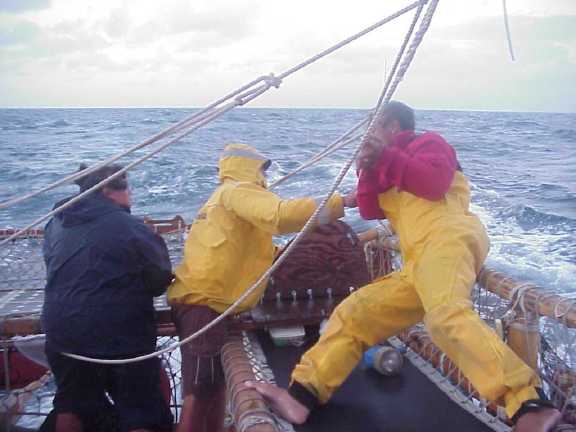
Tightening sheets in stormy weather. Tahiti-Hawai‘i 2000.
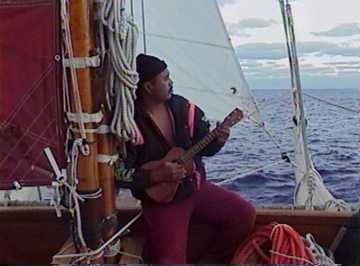
When crew members are off watch, they rest, read, write in their journals, wash laundry, make music or simply relax and enjoy being out at sea. Time can pass slowly although this is the exception rather than the rule. Being away from home for extended periods of time, the crew does experience ups and downs and homesickness is not uncommon, especially for the new crew members.
Mona Shintani on his uke. Hiva Oa to Pitcairn, 1999.
Older crew members have the responsibility to make sure that everyone gets through these low points.Roles and Duties of Hokule‘a Crew Members
Sailing Hokule'a is a rigorous job and it requires the participation of all crew members on board. To ensure that the canoe sails safely and efficiently, each person fills a specific role. Jobs vary from that of the navigator, to those crew members whose primary responsibility is documentation of the voyage for historical purposes. Providing they fill the job requirements, both men and women can hold the various positions described below.The person who carries the overall responsibility for the canoe and crew is the sailmaster. While he serves primarily in an advisory capacity, it is the sailmaster who has the final say on the canoe's sailing strategy and course and on all other operations of the canoe. He works in consultation with the navigators and captain.
The navigator, who is usually the same person as the sailmaster, determines the canoe's course, sets the sailing strategy, and determines the direction in which the crew will sail Hokule'a. He must stay oriented at all times, and this means that generally he is assigned no other duties aboard the canoe. In order to keep track of the canoe's direction, the navigator stays awake 20 hours a day, seated on a platform at the aft of the canoe. The navigator gives direction to the crew through the captain. The crew on watch steers the canoe under the direction of the navigator and captain, working the steering sweep and paddles and trimming the sails to stay on course while maintain the maximum speed.

The captain's primary responsibility is the safe sailing of Hokule'a and this encompasses everything from ensuring that a capable well-trained crew is on board to the physical maintenance of the canoe. Much preparation is done before the crew and canoe ever leave shore and this is done under the captain's direction. In consultation with the other officers, the captain schedules work parties for preparing the canoe to sail. Re-lashing canoe parts, mending sails, cleaning and painting Hokule'a's hulls are just some examples of the kinds of work done before sailing.
Another big job is loading the canoe with food, water, and safety gear required on voyages. Again, it is the captain's responsibility to ensure that this is done properly.
At sea, the captain executes all decisions relative to sailing. Once the navigator sets the sailing strategy, it is the captain who directs the crew to hoist, drop or change sails and he determines which steering paddles to use. He is responsible for coo rdinating activities with the escort vessel and providing a daily work schedule for the watch captains. The captain holds overall responsibility for maintaining the canoe's inventory, and he decides when and if to ration food and water. When approaching l and, the captain handles most administrative matters, such as dealing with customs officials and maintaining the canoe's security while it is moored.
The watch captains direct those crew members assigned to their watch or work shifts, carrying out instructions relayed by the captain. The watch captain is responsible for ensuring that his crew is up and on duty in a timely fashion, assigning specific st eering positions to his crew and directing rotations through the various positions, going through the safety check list, and maintaining his watch log. He is responsible for maintenance of the canoe during his watch, including cleaning up after meals. Add itionally, the watch captain is responsible for monitoring the safety, health and morale of his crew.
Other tasks are assigned to crew members and carried out in addition to standing watch. The medical officer, usually a certified doctor, is aboard Hokule'a for each long voyage. His primary responsibility is the health of the crew. It is the medical offic er's responsibility to ensure that the canoe is equipped with all medications and medical supplies needed for a long journey. When the canoe is in foreign ports, the medical officer is also responsible for attending to the crew's health and medical needs on shore.
The radio operator handles all radio transmissions between Hokule'a, and the escort vessel and between the canoe and land. He maintains an accurate log of all radio traffic, and is responsible for the upkeep of the radio equipment.
A designated carpenter oversees all repairs done on the canoe. He also maintains the tool inventory. An assigned electrician maintains all electrical systems.
The cook plans the canoe's menus, maintains iventory of food supplies, and does most of the cooking. While this may not seem like an important job, the ability of the cook is directly related to the morale of the crew as meals are the highlight of each da y. Good nutrition is also an important factor in maintaining the health of the crew.
The quartermaster is responsibile for provisioning the canoe--loading food, water and all needed supplies, and for maintaining Hokule'a's inventory. While this is not an on board job, it is critical to the safe and efficient sailing of the canoe. Weight m ust be evenly distributed for optimum sailing.
Fishing off of the canoe is not a leisure time activity, but an actual designated job, and one crew member is responsible for setting and bringing in fishing lines each day and for landing all catches. Fresh fish provide an important food source at sea.
Documentors keep historical records of the voyage by various means including writing, video and audio taping.
The safety officer is responsible for all safety and emergency systems and equipment. Life jackets, life preservers, flares and fire extinguishers are just some examples of the gear the canoe carries. In addition, all crew members must be trained in man o verboard and fire procedures.
Crew responsibilities are exactly the same as the watch captain, with the exception of the administrative duties. Off watch, crew members main obligation is to keep out of the way of those on duty.
Leisure time is spent in a variety of ways including resting, reading, writing, and taking care of personal chores (laundry, cleaning out compartments etc.). In the event of bad weather or an emergency and an all hands on deck call, all of the crew member s are expected to work.
All jobs on the canoe, no matter how routine they may seem, are important to the overall safe sailing of Hokule'a. A crew member's most critical responsibility is to realize that his crewmates depend upon him to carry out his assigned duties, and to work well as part of a team.
March 08, 2012
Our Blue Canoe - voyaging canoe
"Our Blue Canoe" article at Proafile:
http://proafile.com/magazine/article/our-blue-canoe
And the "trailer" at YouTube:
http://www.youtube.com/watch?v=UR_nk7ZEKcE&feature=player_embedded#!
http://proafile.com/magazine/article/our-blue-canoe
And the "trailer" at YouTube:
http://www.youtube.com/watch?v=UR_nk7ZEKcE&feature=player_embedded#!
From Proafile's article: "The film is part of a larger initiative called the “Vaka Motu” project, by Pacific Voyagers. The vision is to connect all Pacific Islands in a sustainable, carbon-neutral fashion via Vaka Motu, thus gaining independence, better infrastructure, and more economic opportunities for remote island communities."
Pacific Voyagers site here:
Contemporary proas
Some contemporary proas. The top two pics are Jzerro. The bottom two are from "Grillabongquixotic":http://grillabongquixotic.wordpress.com/2011/07/02/a-report-on-my-version-of-gary-dierking%C2%B4s-t2-pacific-flying-proa/
March 02, 2012
The Navigators - Pathfinders of the Pacific
"Site, text, and images Copyright © 2002 Sam Low. All rights reserved. Any or all content may not be used without Sam's permission" - My apologies to Sam for using this but I don't thing he'd mind!
Sam Low's Screening Room - a page about the making of his benchmark film The Navigators - Pathfinders of the Pacific:
http://www.samlow.com/screeningroom/navigators-clippings.html
"The Navigators - Pathfinders of the Pacific" - was first shown nationally in prime time on PBS in 1983 and later broadcast internationally in Europe and South America. It was awarded a Cine Golden Eagle, a Blue Ribbon at the American Film Festival and a Silver Anvil and has been screened at the Massachusetts Institute of Technology film series, Film/Video International at Castle Hill, Honolulu Film Festival, Margaret Mead Film Festival, Nantes Festival International de film du Mer, among other venues."
Sam Low's Screening Room - a page about the making of his benchmark film The Navigators - Pathfinders of the Pacific:
http://www.samlow.com/screeningroom/navigators-clippings.html
"The Navigators - Pathfinders of the Pacific" - was first shown nationally in prime time on PBS in 1983 and later broadcast internationally in Europe and South America. It was awarded a Cine Golden Eagle, a Blue Ribbon at the American Film Festival and a Silver Anvil and has been screened at the Massachusetts Institute of Technology film series, Film/Video International at Castle Hill, Honolulu Film Festival, Margaret Mead Film Festival, Nantes Festival International de film du Mer, among other venues."
![]() |
| Filming the interview with Mau |
![]() |
| Filming a wedding on Satawal |
A link here to The New Film Company who sells the film:
February 10, 2012
Premier of a Mau Piailug page
A new page has been set up specifically for Mau here:
http://wavetying.blogspot.com/p/mau-piailug.html
Subscribe to:
Posts (Atom)